
Matches in Nanopublications for { ?s <http://schema.org/description> ?o ?g. }
- c7f1c1fa-caa1-4d3f-8b81-9adf18090c74 description "implicit collection jobs properties" assertion.
- c891c902-f3d5-4ea8-b682-8553ea7ab434 description "libraries properties" assertion.
- de997230-e253-4ea1-8ef3-367cad87f52e description "collections properties" assertion.
- b3cb61d2-2f69-478a-8d99-b015043391d4 description "" assertion.
- f358985c-9db4-42f0-b063-48d0d154953a description "" assertion.
- d6ac4e94-edcb-4272-a58f-9f6bce8c7079 description "The objective is to achieve with societal engagement better understanding, reduction/removal of marine litter and plastics in a bottom up effort to support the MSFD, along with the Circular Economy Strategy and the European Strategy for Plastics in a Circular Economy. Citizens and local administrations will be targeted in order to raise their awareness about the ML issue and importance of prevention to avoid environmental damage and societal costs. This will be done with specific dissemination campaigns, including participatory and large scale clean up aimed at identifying and tracking ML with MAELSTROM app for an efficient disposal and treatment. The engagement requires people to think about plastic trash, citizen responsibility and circular economy potential. All these actions are expected to change the way they perceive ML, and how themselves can be part of change and make a difference." assertion.
- a31eb2c0-14c0-4a4b-95f5-8908cf4fd828 description "July 26, 2021 https://www.maelstrom-h2020.eu/maeldrop-4-many-types-of-plastics/" assertion.
- zenodo.14929727 description "Gomes, I. (2021). D9.1 Plan for Communication and Dissemination. MAELSTROM Project. https://doi.org/10.5281/zenodo.14929727" assertion.
- zenodo.14929837 description "Gomes, I. (2022). D9.3 First Interim communication and dissemination report. MAELSTROM Project. https://doi.org/10.5281/zenodo.14929837" assertion.
- zenodo.14930003 description "Gomes, I. (2023). D9.4 Second Interim communication and dissemination report. MAELSTROM Project. https://doi.org/10.5281/zenodo.14930003" assertion.
- zenodo.14930916 description "Gomes, I. (2022). D9.2 Final Version of the Plan for Communication and Dissemination. MAELSTROM Project. https://doi.org/10.5281/zenodo.14930916" assertion.
- zenodo.15545803 description "Gomes, I. (2025). D9.5 Final Communication and Dissemination Report. MAELSTROM Project. https://doi.org/10.5281/zenodo.15545803" assertion.
- c8cb2eb7-8f64-44d4-910a-a2b7baf98b64 description "The objective is to support of the SDG 14 Life Below Water and the European Strategy for Plastics within a Circular Economy vision by coordinating with and integrating the efforts of projects under the same topic, as well as projects selected under other topics in H2020 for the reduction, removal and sustainable management of ML in the coastal areas. It is based upon intensive coordination and networking with best cases of blue technology for removal of ML for activities integration and joint demonstrations (BG-Blue Growth, the MSCA-Marie Sklodowska Curie Action; ERC-European Research Council; SME Instrument; CIRC – Circular Economy; LEIT-Leadership in enabling and industrial technologies; BBI JU-Bio-based Industries Joint Undertaking) for impact maximisation. This is in support of the Marine Scientific Research and Transfer of Marine Technology at EU level and in the framework of UNCLOS, actively contributing to the BlueMed Pilot action on a Healthy Plastic-free Mediterranean Sea." assertion.
- 14679311 description "Gomes, I., Mira Veiga, J., Iglesias, I., Vieira, L., Kett, G., SALLÉ, D., Pessoa, A., Nerantzis, E. A., Zingariello, D., Betteto, G., Poletto, D., MOSCHINO, V., & Madricardo, F. (2024). MAELSTROM Legacy Document. Zenodo. https://doi.org/10.5281/zenodo.14679311" assertion.
- 15495632 description "Kett, G., Vieira, L. R., Sousa Pinto, I., Iglesias, I., Antunes, S., & Nogueira, S. (2025). D7.1 Creation and Operationalization of a thematic Working Group on Marine Litter and Plastic Strategy. Zenodo. https://doi.org/10.5281/zenodo.15495632" assertion.
- 15544416 description "Vieira, L., Kett, G., Sousa-Pinto, I., Iglesias, I., Antunes, S., MOSCHINO, V., Betteto, G., & Nerantzis, E. A. (2024). D7.2 Best Practices Sheets Database. MAELSTROM Project. https://doi.org/10.5281/zenodo.15544416" assertion.
- 15544500 description "Gomes, I., Polo, L., Vieira, L., & Sousa Pinto, I. (2021). D7.3 Joint Strategy and Dissemination Plan of Networking Actions. MAELSTROM Project. https://doi.org/10.5281/zenodo.15544500" assertion.
- 15545625 description "Poletto, D., Senem Nurel, Z., Vieira, L. R., Kett, G., & Sousa-Pinto, I. (2024). D7.4 Unified Reports on Sideevents at the Business2Sea and at the International Venice Boat Show. MAELSTROM Project. https://doi.org/10.5281/zenodo.15545625" assertion.
- 15640957 description "Madricardo, F. (2022). Policy Brief - 08 regulatory changes that can make marine litter removal and reintroduction in the economy viable at a large scale. MAELSTROM Project. https://doi.org/10.5281/zenodo.15640957" assertion.
- bc89e60b-9483-46fa-80c5-ba0f9c8dfec4 description "The objective is supporting the Circular Economy Strategy, the European Strategy for Plastics in a Circular Economy aiming at having all typologies of ML and plastics removed identified, sorted and reused. MAELSTROM will combine innovative processes to recover valuable material for a new life cycle, demonstrating that a sustainable plastics economy can be possible from marine litter and providing a strategic circular marine litter vision for the future. This will be pursued by involving diversified players in the plastic value chain and deploying a mix of ML treating technologies made of physical, chemical solutions. The conversion of solid waste feedstocks into chemical precursors, polymers, materials, etc. shall foster an ecosystem-based bio-industry, innovative manufacturing processes in line with the circular economy approach. The pyrolysis waste-to-energy plant will also produce primary power and 2nd generation fuel. This fuel will be utilized to co-supply MAELSTROM raft energy demands for the removal of seabed/water column ML. The set of ML derived products will be thoroughly analysed for new market prospects within a new industrial life cycle." assertion.
- j.eti.2024.103971 description "M.M. Parascanu, J. Clavell Díaz, M. Rodriguez Mijangos, M. Isasa Sarralde, D. Salle, A. Alonso Galdames, Life cycle assessment of an innovative seabed cleaning platform for marine litter removal in aquatic ecosystems, Environmental Technology & Innovation, Volume 37, 2025, 103971, ISSN 2352-1864, https://doi.org/10.1016/j.eti.2024.103971. (https://www.sciencedirect.com/science/article/pii/S2352186424004474) Abstract: Plastic consumption is projected to rise significantly over the coming decades, especially in developing economies, leading to increased plastic leakage into the environment and the accumulation of waste in ecosystems. Despite the urgent need to address this issue, the environmental implications of marine litter removal technologies have been largely unexplored. This paper addresses this gap by presenting the first comprehensive Life Cycle Assessment (LCA) of the Seabed Cleaning Platform, a novel cable-based underwater robot developed by TECNALIA to remove litter selectively and efficiently from the seabed and lower water column. The Seabed Cleaning Platform introduces significant advancements in marine litter removal by enabling a more efficient and cost-effective process. Its innovative design allows for selective and automated removal of identified debris, ranging from microplastics (>5 mm) to large items. Additionally, the system is designed to operate in a manner that benefits the marine ecosystem, mitigating the environmental impact of traditional clean-up efforts. The LCA provides an in-depth evaluation of the platform's environmental performance throughout its entire life cycle. Results indicate that the use and maintenance phases account for 70.9 % of the total environmental impact. Sensitivity analyses highlight optimization opportunities, such as increasing operational time and waste collection volume to reduce the environmental impact per unit of waste removed and replacing the generator with a smaller, more efficient model to minimize fuel consumption. This study marks an important step in applying LCA to emerging marine litter removal technologies. Unlike analyses focused exclusively on operational efficiency, this research quantifies the environmental trade-offs and scalability potential of the Seabed Cleaning Platform. These insights provide valuable information for improving the environmental performance of marine litter removal technologies and guide future developments in this field. Keywords: Life cycle assessment; Marine litter removal; Seabed cleaning platform; Cable robotics" assertion.
- 15544282 description "Nerantzis, E. A. (2024). D8.6 Public summary on the Exploitation Plan. MAELSTROM Project. https://doi.org/10.5281/zenodo.15544282" assertion.
- 15544342 description "Scarpa, M., & Sferra, D. (2024). D8.5 Public summary on Report on Costs Benefits Analysis. MAELSTROM Project. https://doi.org/10.5281/zenodo.15544342" assertion.
- 15545143 description "Anne-Sophie Høgh Mahler, Kærsgaard Hansen, C., Eltzholtz, J., Krogh Olsen, P., Bach Velling Villadsen, I., Betteto, G., & Garcia Arrieta, S. (2024). D6.6 Processed ML Quality assessment for marketisation. MAELSTROM Project. https://doi.org/10.5281/zenodo.15545143" assertion.
- 15545179 description "Mendizabal, M., & Garcia, S. (2025). D6.3 Report on the marine thermoplastic recycling capabilities. MAELSTROM Project. https://doi.org/10.5281/zenodo.15545179" assertion.
- 15545221 description "Anne-Sophie Høgh Mahler, Kærsgaard Hansen, C., Eltzholtz, J., Krogh Olsen, P., Strandgaard Borgbjerg, A. M., Grønbech Møller, M., Volsmann Simonsen, M., Bach Velling Villadsen, I., & Faussone, G. C. (2025). D6.5 Low temperature pyrolysis treatment(s) of collected ML. MAELSTROM Project. https://doi.org/10.5281/zenodo.15545221" assertion.
- 15545289 description "Magdalena Parascanu, M., & Clavell Diaz, J. (2024). D6.7 Report on the life cycle assessment (LCA) of the MAELSTROM automatic systems and marine litter processing technologies. MAELSTROM Project. https://doi.org/10.5281/zenodo.15545289" assertion.
- 15546167 description "Betteto, G., Poletto, D., de Carolis, C., & Sferra, D. (2025). D6.4 Report on the ML processed through mechanical recycling for hard to recycle plastics and organic wastes. MAELSTROM Project. https://doi.org/10.5281/zenodo.15546167" assertion.
- 15e54fde-611f-49cc-8951-e15c650f0cb2 description "## Flooding in Saarland We showcase the usage of JupyterGIS for creating geographical maps showing the HQ 100 flooding zones in Saarland along with images from Wikimedia Commons. These notebooks showcase how to use JupyterGIS. We use JupyterGIS on the UseGalaxy.eu. The tool can be launched from [JupyterGIS in Galaxy Europe](https://usegalaxy.eu/root?tool_id=interactive_tool_jupytergis_notebook). Please prior to use it, register to [usegalaxy.eu](https://usegalaxy.eu/login/start) and authenticate yourself before starting it. To help new users get started, there are two tutorials available: - [Intro to JupyterGIS](https://jupytergis.readthedocs.io/en/latest/user_guide/tutorials/01-intro/index.html) a step-by-step guide for new users. - [Collaborative Features Tutorial](https://training.galaxyproject.org/training-material/topics/climate/tutorials/jupytergis_collaboration/tutorial.html) — a guide for exploring real-time editing and shared annotations. 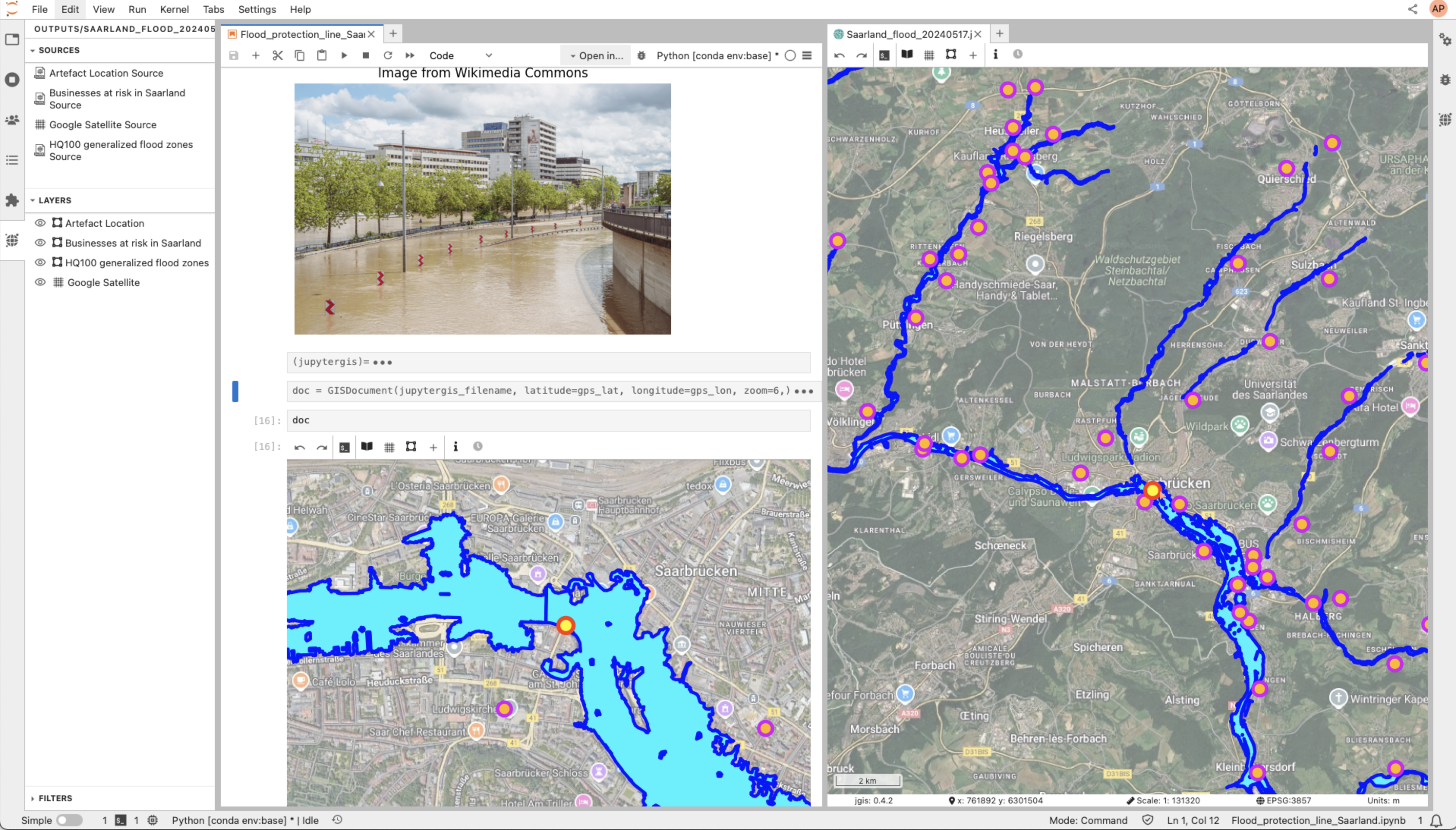" assertion.
- 75bdf7ea-f6aa-4cab-8911-e59e6fda7732 description "Flood in Saarland with JupyterGIS." assertion.
- 563033_1_En_4_Fig5_HTML.png description "Example of monthly mean reference height (i.e., at 2 m) air temperature (TREFHT) expressed in kelvin obtained with CESM2.3 and corresponding to a typical situation in January 2000, starting from a global 1 grid which is progressively increased by a factor of 4 over the Arctic, and exhibits a further 2 resolution refinement over Greenland and Iceland." assertion.
- 231a8eab-7612-4b18-b4d1-dd7cf68628cf description "Research Object related to the paper: Iaquinta, J., Fouilloux, A. (2025). Unlocking the Potential of Containers in Scientific Computing to Achieve Bitwise Reproducibility, Portability and Performance. In: Azab, A., Malkiewicz, T. (eds) Nordic e-Infrastructure Tomorrow. NeIC 2024. Communications in Computer and Information Science, vol 2398. Springer, Cham. https://doi.org/10.1007/978-3-031-86240-3_4" assertion.
- 5dc5cac2-af40-4ad8-aed5-84b9ce73e3e7 description "This folder contains the monthly reports" assertion.
- de0e7ad3-4e25-458b-b1ab-1889aaa4553c description "Folder containing the generated papers. The papers were generated by ChatGPT or other LLMs. All the generated documents used free plan e.g. the documents were generated at no cost." assertion.
- 06d1ede9-934b-4adf-bb9c-095250a5b0ae description "Version 1.0: We gave to GPT-4.1mini (free version) all the AIDA sentences generated for the paper 10.1007_978-3-031-86240-3_4 and asked to rewrite it following the template Abstract, Keywords, Introduction, Background, Discussion, Conclusion, References. We read the generated paper to spot any mistakes and we highlighted inconsistancies in yellow." assertion.
- 12d48518-fe23-4a16-bf0d-1219e0c8fc47 description "Version 2.0 generated by ChatGPT (April 2025, sikt.no). Could you write a scientific paper of 4 pages with the following sections “Abstract, Keywords, Introduction, Background, Discussion, Conclusion, References. ” with a text that needs to be long to be published in a good journal and the paper should be based on the following AIDA sentences that you will need to all references in the text (make sure to add all the AIDA sentences in the text) and add in the reference section. The reference section should list all the AIDA sentences so you need to make sure all of them are referenced in the generated text. ensure all the AIDA sentences are included and referenced properly. This will ensure completeness and meet the requirements for the publication.:" assertion.
- 978-3-031-86240-3_4 description "List all the nanopublications related to the paper with DOI: https://doi.org/10.1007/978-3-031-86240-3_4" assertion.
- 2b7e42ca-0223-446d-b621-d1d55ff37602 description "Within the MAELSTROM project two complementary marine litter removal technologies are developed and tested. An automated seabed cleaning platform has been developed with a cable-robot able to remove marine litter from the seafloor at demo locations in the coastal area near Venice (Italy), and a Bubble Barrier system will be implemented to remove marine litter from the water column in the Ave estuary (Portugal). In order to select locations where the technologies can best be applied and to assess the impact of the litter removal on marine life, we have set-up and applied numerical models. Furthermore, results of field observations that were carried out in the framework of MAELSTROM are analysed and are put into context using the numerical modelling results." assertion.
- 74879f7d-039a-4e11-9382-2778955908aa description "Demo site 2" assertion.
- 772206d8-d680-4ed4-aa0f-a86482c5b428 description "Demo site 2" assertion.
- 14918765 description "Buschman, F. A., Iglesias, I., Ghezzo, M., McKiver, W., De Pascalis, F., Zaggia, L., Boisgontier, H., & Tiessen, M. (2023). D2.2 Numerical modelling and field campaigns to support litter removal at the demo sites. MAELSTROM Project. https://doi.org/10.5281/zenodo.14918765" assertion.
- 14920205 description "Ghezzo, M., MOSCHINO, V., Galvez, D., Mira Veiga, J., Bocci, M., Iglesias, I., Vieira, L., Sousa Pinto, I., Antunes, S. C., & Correia, A. M. (2021). D2.1 Report on the characterization of major sources of marine litter and macro-plastic in the demo sites. MAELSTROM Project. https://doi.org/10.5281/zenodo.14920205" assertion.
- 35e7cfd3-44d6-4979-8322-347634114abf description "A bubble Barrier that removes litter from rivers is being applied in the Ave estuary (Portugal) in the framework of the MAELSTROM Project. In order to identify the location where the technology could possibly best be applied and to assess the impact of the litter removal on marine life, MAELSTROM makes use of numerical models. Facing the limited field data and absence of available models, we carried out field campaigns, set-up a hydrological model for the Ave river basin and set-up a hydrodynamic model for the estuarine region. The field studies included a bathymetric survey, short-term (12.5 hours) and long-term (several weeks) campaigns. Aiming to understand the temporal and spatial variation of the flow velocity in the estuary, and particularly in the area where the Bubble Barrier system is planned to be implemented, we have analysed observations from a boat sailing across the estuary (short-term), we have analysed observations at selected locations (long-term) and we have set-up a 3-dimensional (3D) hydrodynamic model to give insight in the flow velocity distribution. Only during the short-term campaigns the river discharge is known, which was relatively low during these campaigns. Since the river discharge is an important condition for the hydrodynamic model, we have only obtained maximal flow velocity maps for low river discharge. For higher river discharge we show a maximal flow velocity observed during a long-term campaign and we estimate maximal flow velocity based on an extreme river discharge." assertion.
- 6542c1af-16f4-4fc1-938e-f9de0557af88 description "The MAELSTROM Project performed a literature survey includes existing databases on marine litter data on the water column, sea floor, estuaries, rivers and beaches. Specifically, the European/Regional Seas review is based on existing publications while the study areas review is based on existing publications and raw data, when available. The review intends to provide the knowledge-base on the characteristics, sources and pathways of marine litter in the two demo sites of the lagoon of Venice (Italy) and the Ave River estuary (Portugal). Specifically, the review aims at: ● improving the understanding of the amounts and types of marine litter occurring in Europe and in particular in the study areas; ● improving the understanding of the main sources and pathways of marine litter in Europe and in particular in the study areas; ● supporting the definition of the input data and assumptions related to marine litter to be used in numerical models of marine litter spatial distribution. To achieve this objective, we assume the following constraints: ● the main focus is on macro-litter; ● the review has a geographic scope focused on the study sites; ● marine litter literature has been analysed to indicate the most probable sources and amount. Here the results related to the Adriatic Sea subregion that is characterised by the presence of many sources of marine litter, including large rivers, big coastal cities, touristic facilities, heavy shipping traffic, intense commercial fisheries and mussel farming." assertion.
- 66662522-48b0-47a1-b805-239300c81a8b description "An automated cable-robot on a platform that removes litter from the sea bed is being applied in demo sites near Venice (Italy) in the framework of the MAELSTROM Project. In order to identify the location where the technology could possibly best be applied and to assess the impact of the litter removal on marine life, MAELSTROM makes use of numerical models. The applied numerical tool consists of a three-dimensional hydrodynamic model that reproduces the water current evolution in the domain of the case study area. While the focus of the project is the Venice lagoon and the Gulf of Venice, the study covers the whole Adriatic Sea, including the sources of marine litter coming from the whole of the Adriatic coastline. The distribution of the marine litter in the Adriatic Sea was assessed by performing the numerical simulations, considering both the land based marine litter sources (rivers and cities), as well as marine sources (aquaculture) using the hydrodynamic model SHYFEM (for more information see the project deliverable D2.2 Numerical modelling and field campaigns to support litter removal at the demo sites)." assertion.
- a6291550-d05c-476b-a2c8-afa6d5651c70 description "The MAELSTROM Project performed a literature survey includes existing databases on marine litter data on the water column, sea floor, estuaries, rivers and beaches. Specifically, the European/Regional Seas review is based on existing publications while the study areas review is based on existing publications and raw data, when available. The review intends to provide the knowledge-base on the characteristics, sources and pathways of marine litter in the two demo sites of the lagoon of Venice (Italy) and the Ave River estuary (Portugal). Specifically, the review aims at: ● improving the understanding of the amounts and types of marine litter occurring in Europe and in particular in the study areas; ● improving the understanding of the main sources and pathways of marine litter in Europe and in particular in the study areas; ● supporting the definition of the input data and assumptions related to marine litter to be used in numerical models of marine litter spatial distribution. To achieve this objective, we assume the following constraints: ● the main focus is on macro-litter; ● the review has a geographic scope focused on the study sites; ● marine litter literature has been analysed to indicate the most probable sources and amount. Here the results related to the NW Portuguese coastal area." assertion.
- 0a19b2b3-0109-4de4-9160-a958f139f8ab description "A bubble Barrier that removes litter from rivers is being applied in the Ave estuary (Portugal) in the framework of the MAELSTROM Project. In order to identify the location where the technology could possibly best be applied and to assess the impact of the litter removal on marine life, MAELSTROM makes use of numerical models. Facing the limited field data and absence of available models, we carried out field campaigns, set-up a hydrological model for the Ave river basin and set-up a hydrodynamic model for the estuarine region. The hydrodynamic numerical model for the Ave estuary was implemented using D-Flow Flexible Mesh (D-Flow FM), which is the hydrodynamic module of the Delft3D Flexible Mesh Suite developed by Deltares (for more information see the project deliverable D2.2 Numerical modelling and field campaigns to support litter removal at the demo sites)." assertion.
- 7bdd7b5d-1b94-4c4b-9ab9-fbbd3a4aaf65 description "A bubble Barrier that removes litter from rivers is being applied in the Ave estuary (Portugal) in the framework of the MAELSTROM Project. In order to identify the location where the technology could possibly best be applied and to assess the impact of the litter removal on marine life, MAELSTROM makes use of numerical models. Facing the limited field data and absence of available models, we carried out field campaigns, set-up a hydrological model for the Ave river basin and set-up a hydrodynamic model for the estuarine region. The hydrodynamic numerical model for the Ave estuary was implemented using D-Flow Flexible Mesh (D-Flow FM), which is the hydrodynamic module of the Delft3D Flexible Mesh Suite developed by Deltares (for more information see the project deliverable D2.2 Numerical modelling and field campaigns to support litter removal at the demo sites)." assertion.
- 9b809a70-34cd-4083-a75d-cf32b4bf7df3 description "n the framework of the MAELSTROM Project, the specific objective for the Portuguese demo site Ave estuary was to understand the flow dynamics in the estuary associated with river discharge and tides, in order to estimate the transport and fate of litter and to help the detailed design of the Bubble Barrier system. Since very limited observations and no flow velocity observations were available for the Ave estuary, Deltares carried out the following activities: - A bathymetric survey was carried out to obtain bed level in the entire estuary, needed for both the set-up of the hydrodynamic model and to prepare for the implementation of the Bubble Barrier system. - Flow velocity and density variation were measured during a tidal cycle (about 13 hours) at selected locations (short-term), during the summer and the winter. - For several weeks (long-term) flow velocity and density were monitored at two locations in the estuary. - In absence of observations, a hydrological model was set-up to obtain river discharge. - Finally, a hydrodynamic model was set-up to obtain flow velocity fields in the area of interest for different tidal and river discharge conditions. This dataset consists in a time series of daily discharge in the second tab. While, the first tab gives an overview of the location and Ave catchment in Portugal. The time series was obtained by running a hydrological model that was set-up for the catchment. Using European data like rainfall, the river discharge was calculated. For more details, see MAELSTROM deliverable 2.2." assertion.
- 5e53ec13-7cdb-4e41-95aa-f48b4206ead4 description "# Towards the FAIRification of a city-level Climate Adaptation Strategy ## Vision & Ambitions This case study seeks to: 1. Enhance the accessibility, usability and clarity of a climate adaptation strategy by applying FAIR (Findable, Accessible, Interoperable, Reusable) principles to both the policy document itself and its underlying climate risk and adaptation data. 2. Support effective science-policy communication by ensuring that climate risk and adaptation information is structured, documented, and presented in a way that is understandable and actionable for policymakers and stakeholders. 3. Point out gaps and improve FAIRness for key datasets by engaging with data providers and data users. ## Description Climate adaptation strategies are essential for guiding responses to climate-related risks at local and regional levels. These strategies often serve as reference documents for policymakers, practitioners, and other stakeholders involved in planning and implementing adaptation measures. However, such documents and datasets are often difficult to locate, interpret, or reuse due to inconsistent formats, insufficient metadata, or unclear communication. The project addresses these challenges and aims to make such documents more accessible by applying FAIR principles to a selected climate adaptation strategy and its associated climate risk and adaptation data, as well as by enhancing data-policy communication and, in this context, the updating process of adaptation strategies. Understanding the needs of city council staff, policymakers, stakeholders, and data users will also be a key focus, to ensure that the data and information provided by the strategy can be effectively integrated into their work. ## FAIR2Adapt Contribution Fair2Adapt supports the FAIRification of climate adaptation strategies and related data by reviewing existing materials, engaging with stakeholders, and promoting FAIR best practices for data management and enhanced science-policy communication. The project aims to improve the accessibility and usability of adaptation information for policy and decision-making. - Reviewing and enhancing climate risk and adaptation strategy documents to ensure alignment with FAIR standards. - Enriching the policy document with machine-readable metadata and standardized vocabularies to improve discoverability and integration with other data sources. - Producing communication approaches that translate complex datasets into actionable, policy-relevant insights based on FAIR criteria. ## Lead Partner adelphi ## External Stakeholders involved in CCA Decision- and policy-makers, knowledge producers (e.g., climate data providers), knowledge brokers (e.g., consultancies), city councils, and other user groups" assertion.
- 1148 description "" assertion.
- 1148 description "" assertion.
- 1148 description "" assertion.
- 1148 description "" assertion.
- 1148 description "" assertion.
- 1148 description "" assertion.
- 1149 description "" assertion.
- 1149 description "" assertion.
- 1149 description "" assertion.
- 1150 description "" assertion.
- 1150 description "" assertion.
- 6388 description "" assertion.
- 6388 description "" assertion.
- 2a889d82-5b8c-48c2-820b-e8da468d64bf description "# Case Study for extending weADAPT and the Climate Connectivity Hub This case study is divided in two sub cases: 1. Connecting the CCA knowledge landscape through weADAPT 2. Connecting and visualising the CCA knowledge landscape through the Climate Connectivity Hub ## 1st sub-case study: Connecting the CCA knowledge landscape through weADAPT ### Vision & Ambitions The goals and tasks of this case study look as follows: 1) Improve weADAPT to support communities, planners, practitioners, students, researchers and policymakers in accessing and sharing climate-resilient adaptation information and strategies that inform local, national, regional, and global policy processes. 2) Break down silos and avoid redundancy, replication, and wasted resources while promoting collaboration, dialogue, and learning, by harnessing the wealth of existing knowledge across various portals, platforms, and publications, and providing guidance on how to connect this knowledge together. 3) Integrate weADAPT in EOSC. Ensure that climate adaptation knowledge is accessible within EOSC, increasing its usability for a broad range of stakeholders. ### Description Users cannot quickly and easily find information, which impedes communication, coordination and collaboration. Knowledge is increasingly online, but fragmented, unstructured and siloed so users find it hard to search and discover information that they may not know exists. weADAPT is a global online knowledge-sharing platform designed to improve access to climate adaptation information, widely used amongst researchers, practitioners and decision-makers. Knowledge on the platform is organized around +25 themes and networks, and the platform also uses keywords to enhance discoverability. This project aims to make climate adaptation knowledge more accessible, discoverable, and usable by developing improved taxonomies and knowledge graphs. We hope it will also improve communication and collaboration between different stakeholders. The project will involve extracting, curating and making climate and non-climate information available. Key sources include climate data, socio-economic scenarios, case studies, adaptation measures, among others) from popular knowledge portals, platforms and publications, all of which are necessary to support the development and implementation of adaptation planning. ### FAIR2Adapt Contribution As part of this F2A case study, we will use AI to analyse the harvested content and automatically construct taxonomies and knowledge graphs.These tool will: - Ensure resources are well-described to be more discoverable on weADAPT; - Facilitatie more intuitive and accessible navigation of climate knowledge on the platform; - Support the development of a a glossary with clearly defined terms. ### Lead Partner SEI ### External Stakeholders involved in CCA Knowledge producers, decision- and policy-makers, knowledge brokers, governmental agencies, citizens. ## 2nd sub-case study: Connecting and visualising the CCA knowledge landscape through the Climate Connectivity Hub ### Vision & Ambitions The goals and tasks of this case study look as follows: 1) Improve the Connectivity Hub to support communities, planners, practitioners, students, researchers and policymakers in accessing and sharing climate-resilient adaptation strategies that inform local, national, regional, and global policy processes. 2) Break down silos and avoid redundancy, replication, and wasted resources while promoting collaboration, dialogue, and learning, by harnessing the wealth of existing knowledge across various portals, platforms, and publications, and providing guidance on how to connect this knowledge together. 3) Integrate the Connectivity Hub in EOSC. ### Description #### Automated adaptation content harvesting and visualisation (Pan-European) Users cannot quickly and easily find information, which impedes communication, coordination and collaboration. Knowledge is increasingly online, but fragmented, unstructured and siloed so users find it hard to search and discover information that they may not know exists. Creating improved taxonomies or knowledge graphs for the area of climate resilience will enhance search capabilities, improve communication and collaboration, and promote a shared understanding. Extract, curate and make available climate and non-climate information (e.g., climate data, socio-economic scenarios, case studies, adaptation measures, among others) from popular knowledge portals, platforms and publications, specifically necessary to support the development and implementation of adaptation planning. ### FAIR2Adapt Contribution Use of AI to analyse the harvested content and automatically construct taxonomies and knowledge graphs to both visualise the content on the Connectivity Hub and ensure resources are more discoverable. When translated into a glossary the taxonomy provides a range of definitions of common terms that are used differently by different communities to further support learning. ### Lead Partner SEI ### External Stakeholders involved in CCA Knowledge producers, decision- and policy-makers, knowledge brokers, governmental agencies, citizens." assertion.
- F2A_WP6_CS4_Catalogue_v2.xlsx?d=wa3d0b77e344340f3acfb4f42af875fcd&csf=1&web=1&e=Ktoujh description "Catalogue of resources and services to be FAIRified and added to the Portuguese National Adaptation Hub" assertion.
- Records%20to%20screen%20V2%2016.05.xlsx?d=w6654b3283d3d42f0b51e950e4de104dd&csf=1&web=1&e=BoRFdA description "Data records from the systematic literature review for the Portuguese National Adaptation Hub. It contains a list of peer-reviewed publications and metadata for each." assertion.
- 2cace03a-fa6d-450a-9192-dd17fe85a941 description "# Developing and testing a FAIR-by-design national adaptation hub ## Vision & Ambitions In this case study, we: 1) Develop data and knowledge management FAIR and open data resources to serve as basis for the design of national adaptation hubs; 2) Test, in practice, the FAIR2Adapt approach to the design of Portugal’s first National Adaptation Hub. ## Description ### Design of national adaptation platforms (Portugal) Countries and regions are under growing pressure to build additional resilience in response to observed and projected climate change. Additionally, Member States and regional governments are expected to adjust their climate policies in response to the EU’s call for a smarter, faster and more systemic adaptation, as set forward in the 2021 EU Strategy on Adaptation to Climate Change. A profusion of national and regional adaptation portals, platforms and other initiatives aiming to support policymakers and practitioners in their adaptation planning has led to confusion amongst users about good practice and what is relevant, salient and credible information. Find, extract, curate and make available climate and non-climate knowledge and information (e.g., climate projections, socio-economic, environmental and demographic data, case studies, adaptation measures, cost-benefit analysis, among others) from relevant CCA-related portals, platforms and publications, necessary to support the adaptation decision-making planning cycle. ## FAIR2Adapt Contribution Create FDOs from selected sources of relevance to adaptation in the Portuguese context, using the FAIRification Framework and other FAIR supporting resources to leverage RoHub services, allowing the establishment of connections between Data and Executable FDOs with Knowledge-related FDOs, that are useful to stakeholders when developing CCA strategies tailored to their local needs. ## Lead Partner FC.ID ## External Stakeholders involved in CCA National, regional and local governmental agencies (Environmental Agency, Regional and Inter-municipal Administrations , Municipalities), knowledge producers (research centres, state laboratories, insurers) and knowledge brokers (academia, consultancies, climate service providers) in Portugal." assertion.
- 2f432569-3648-4885-bb84-bc9507c5187a description "Parallel session at the European Climate Change Adaptation Conference (ECCA) in Rimini - Italy" assertion.
- 1152 description "" assertion.
- 1152 description "" assertion.
- 1276 description "" assertion.
- 1278 description "" assertion.
- 1278 description "" assertion.
- 1278 description "" assertion.
- 1278 description "" assertion.
- 1278 description "" assertion.
- 1278 description "" assertion.
- 1278 description "" assertion.
- 1278 description "" assertion.
- 1892 description "" assertion.
- 1892 description "" assertion.
- 1892 description "" assertion.
- 1892 description "" assertion.
- 1892 description "" assertion.
- 1892 description "" assertion.
- 1892 description "" assertion.
- 1892 description "" assertion.
- 1892 description "" assertion.
- 632 description "" assertion.
- 632 description "" assertion.
- 632 description "" assertion.
- 632 description "" assertion.
- 632 description "" assertion.
- 632 description "" assertion.
- 632 description "" assertion.
- 632 description "" assertion.
- 632 description "" assertion.
- 632 description "" assertion.
- 632 description "" assertion.
- 6389 description "" assertion.
. Please prior to use it, register to [usegalaxy.eu](https://usegalaxy.eu/login/start) and authenticate yourself before starting it. To help new users get started, there are two tutorials available: - [Intro to JupyterGIS](https://jupytergis.readthedocs.io/en/latest/user_guide/tutorials/01-intro/index.html) a step-by-step guide for new users. - [Collaborative Features Tutorial](https://training.galaxyproject.org/training-material/topics/climate/tutorials/jupytergis_collaboration/tutorial.html) — a guide for exploring real-time editing and shared annotations. "](?object=%22%23%23%20Flooding%20in%20Saarland%0A%0AWe%20showcase%20the%20usage%20of%20JupyterGIS%20for%20creating%20geographical%20maps%20showing%20the%20HQ%20100%20flooding%20zones%20in%20Saarland%20along%20with%20images%20from%20Wikimedia%20Commons.%0A%0AThese%20notebooks%20showcase%20how%20to%20use%20JupyterGIS.%0A%0AWe%20use%20JupyterGIS%20on%20the%20UseGalaxy.eu.%20The%20tool%20can%20be%20launched%20from%20%5BJupyterGIS%20in%20Galaxy%20Europe%5D(https%3A%2F%2Fusegalaxy.eu%2Froot%3Ftool_id%3Dinteractive_tool_jupytergis_notebook).%20Please%20prior%20to%20use%20it%2C%20register%20to%20%5Busegalaxy.eu%5D(https%3A%2F%2Fusegalaxy.eu%2Flogin%2Fstart)%20and%20authenticate%20yourself%20before%20starting%20it.%0A%0ATo%20help%20new%20users%20get%20started%2C%20there%20are%20two%20tutorials%20available%3A%0A-%20%5BIntro%20to%20JupyterGIS%5D(https%3A%2F%2Fjupytergis.readthedocs.io%2Fen%2Flatest%2Fuser_guide%2Ftutorials%2F01-intro%2Findex.html)%20a%20step-by-step%20guide%20for%20new%20users.%0A-%20%5BCollaborative%20Features%20Tutorial%5D(https%3A%2F%2Ftraining.galaxyproject.org%2Ftraining-material%2Ftopics%2Fclimate%2Ftutorials%2Fjupytergis_collaboration%2Ftutorial.html)%20%E2%80%94%20a%20guide%20for%20exploring%20real-time%20editing%20and%20shared%20annotations.%20%0A%0A%0A!%5BHamburg%20Urban%20Data%20Poral%20for%20flood%20analysis%5D(https%3A%2F%2Fraw.githubusercontent.com%2FFAIR2Adapt%2Fsaarland-flooding%2Frefs%2Fheads%2Fmain%2Fstatic%2Fsaarland_map_output.png)%22)
